Author: csonea

  • Why Most Digital Marketing Strategies Fail (And What to Do Instead)

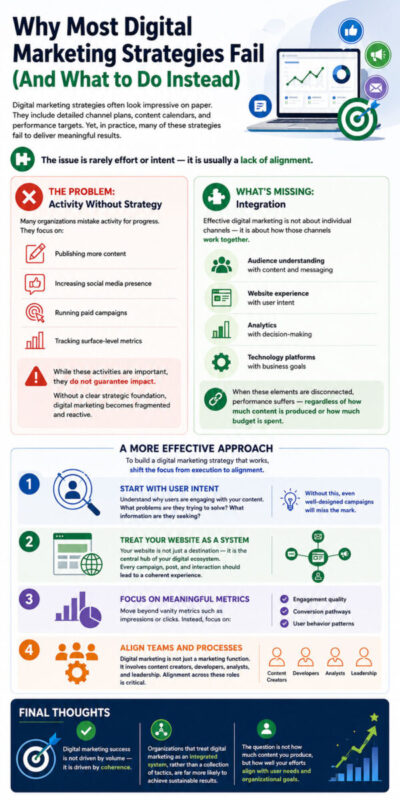
    Digital marketing strategies often look impressive on paper. They include detailed channel plans, content calendars, and performance targets. Yet, in practice, many of these strategies fail to deliver meaningful results.

    The issue is rarely effort or intent — it is usually a lack of alignment.

    The Problem: Activity Without Strategy

    Many organizations mistake activity for progress. They focus on:

    • Publishing more content
    • Increasing social media presence
    • Running paid campaigns
    • Tracking surface-level metrics

    While these activities are important, they do not guarantee impact. Without a clear strategic foundation, digital marketing becomes fragmented and reactive.

    What’s Missing: Integration

    Effective digital marketing is not about individual channels — it is about how those channels work together.

    A strong strategy aligns:

    • Audience understanding with content and messaging
    • Website experience with user intent
    • Analytics with decision-making
    • Technology platforms with business goals

    When these elements are disconnected, performance suffers — regardless of how much content is produced or how much budget is spent.

    A More Effective Approach

    To build a digital marketing strategy that works, shift the focus from execution to alignment.

    1. Start with user intent

    Understand why users are engaging with your content. What problems are they trying to solve? What information are they seeking?

    Without this, even well-designed campaigns will miss the mark.

    2. Treat your website as a system

    Your website is not just a destination — it is the central hub of your digital ecosystem. Every campaign, post, and interaction should lead to a coherent experience.

    3. Focus on meaningful metrics

    Move beyond vanity metrics such as impressions or clicks. Instead, focus on:

    • Engagement quality
    • Conversion pathways
    • User behavior patterns

    4. Align teams and processes

    Digital marketing is not just a marketing function. It involves content creators, developers, analysts, and leadership. Alignment across these roles is critical.

    Final Thoughts

    Digital marketing success is not driven by volume — it is driven by coherence.

    Organizations that treat digital marketing as an integrated system, rather than a collection of tactics, are far more likely to achieve sustainable results.

    The question is not how much content you produce, but how well your efforts align with user needs and organizational goals.
  • Top Ten Benefits of Using Web Analytics

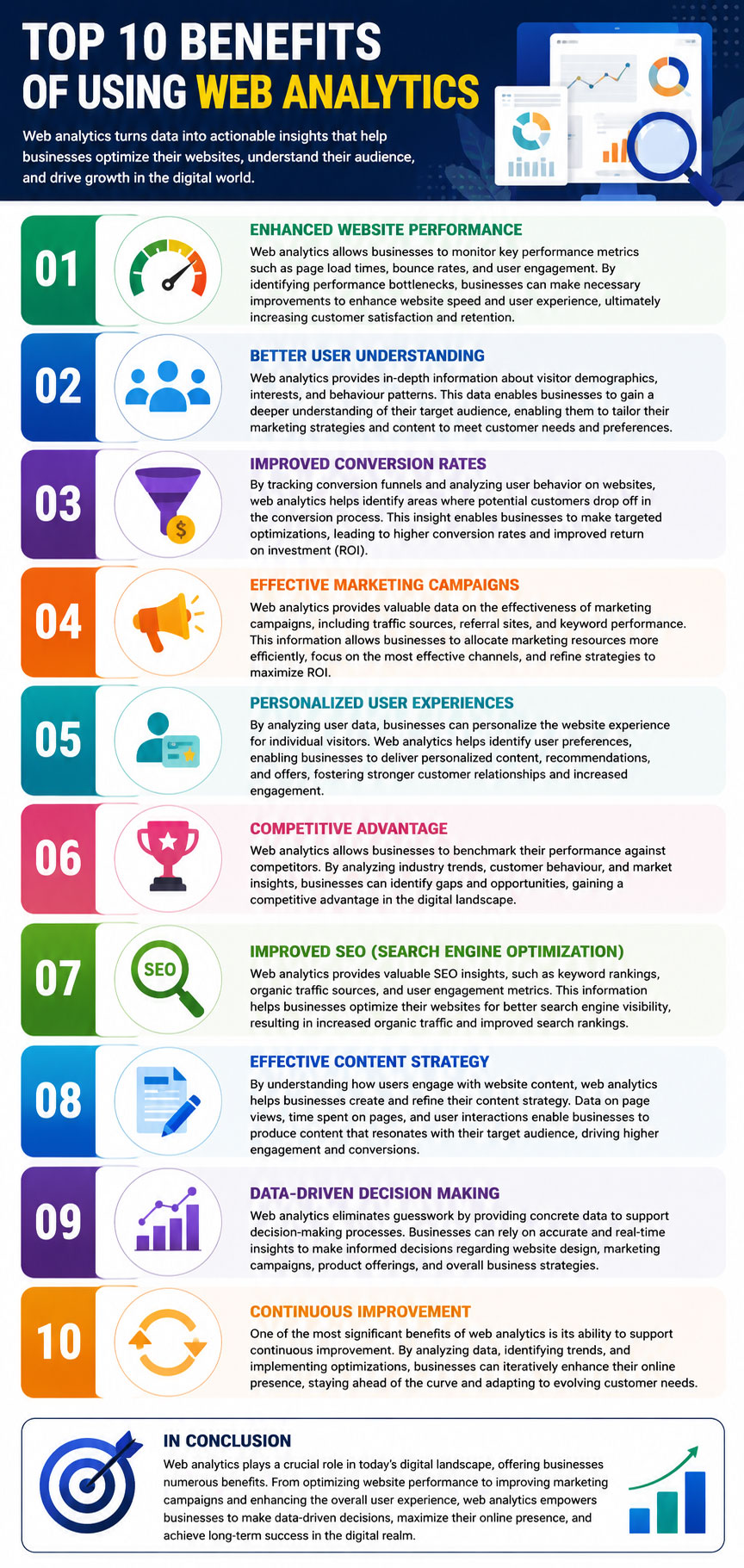
    Top Ten Benefits of Using Web Analytics Infographic

    In the fast-paced digital world, analyzing user behaviour online has become a must for every successful business. With an abundance of free and paid tools available on the market, web analytics has become an essential tool for businesses and organizations of all sizes. By collecting and analyzing data about your website performance, user behaviour, and marketing efforts, web analytics provides valuable insights that can drive informed decision-making. In this article, we will explore the top ten benefits of using web analytics and how it empowers businesses to optimize their online presence.

    Enhanced Website Performance

    Web analytics allows businesses to monitor key performance metrics such as page load times, bounce rates, and user engagement. By identifying performance bottlenecks, businesses can make necessary improvements to enhance website speed and user experience, ultimately increasing customer satisfaction and retention.

    Better User Understanding

    Web analytics provides in-depth information about visitor demographics, interests, and behaviour patterns. This data enables businesses to gain a deeper understanding of their target audience, enabling them to tailor their marketing strategies and content to meet customer needs and preferences.

    Improved Conversion Rates

    By tracking conversion funnels and analyzing user behavior on websites, web analytics helps identify areas where potential customers drop off in the conversion process. This insight enables businesses to make targeted optimizations, leading to higher conversion rates and improved return on investment (ROI).

    Effective Marketing Campaigns

    Web analytics provides valuable data on the effectiveness of marketing campaigns, including traffic sources, referral sites, and keyword performance. This information allows businesses to allocate marketing resources more efficiently, focus on the most effective channels, and refine strategies to maximize ROI.

    Personalized User Experiences

    By analyzing user data, businesses can personalize the website experience for individual visitors. Web analytics helps identify user preferences, enabling businesses to deliver personalized content, recommendations, and offers, fostering stronger customer relationships and increased engagement.

    Competitive Advantage

    Web analytics allows businesses to benchmark their performance against competitors. By analyzing industry trends, customer behaviour, and market insights, businesses can identify gaps and opportunities, gaining a competitive advantage in the digital landscape.

    Improved SEO (Search Engine Optimization)

    Web analytics provides valuable SEO insights, such as keyword rankings, organic traffic sources, and user engagement metrics. This information helps businesses optimize their websites for better search engine visibility, resulting in increased organic traffic and improved search rankings.

    Effective Content Strategy

    By understanding how users engage with website content, web analytics helps businesses create and refine their content strategy. Data on page views, time spent on pages, and user interactions enable businesses to produce content that resonates with their target audience, driving higher engagement and conversions.

    Data-Driven Decision Making

    Web analytics eliminates guesswork by providing concrete data to support decision-making processes. Businesses can rely on accurate and real-time insights to make informed decisions regarding website design, marketing campaigns, product offerings, and overall business strategies.

    Continuous Improvement

    One of the most significant benefits of web analytics is its ability to support continuous improvement. By analyzing data, identifying trends, and implementing optimizations, businesses can iteratively enhance their online presence, staying ahead of the curve and adapting to evolving customer needs.

    In conclusion. web analytics plays a crucial role in today’s digital landscape, offering businesses numerous benefits. From optimizing website performance to improving marketing campaigns and enhancing the overall user experience, web analytics empowers businesses to make data-driven decisions, maximize their online presence, and achieve long-term success in the digital realm.

  • Embracing the Mobile Revolution: The Rise of Mobile E-commerce

    We live in a completely interconnected world, where mobile devices have become an integral part of our daily lives. From communication and entertainment to accessing information, we rely heavily on our smartphones and tablets. Not surprisingly, the realm of e-commerce has also witnessed a significant shift towards mobile platforms. In this blog post, we will explore the growing prominence of mobile e-commerce and how it is reshaping the way we shop online.

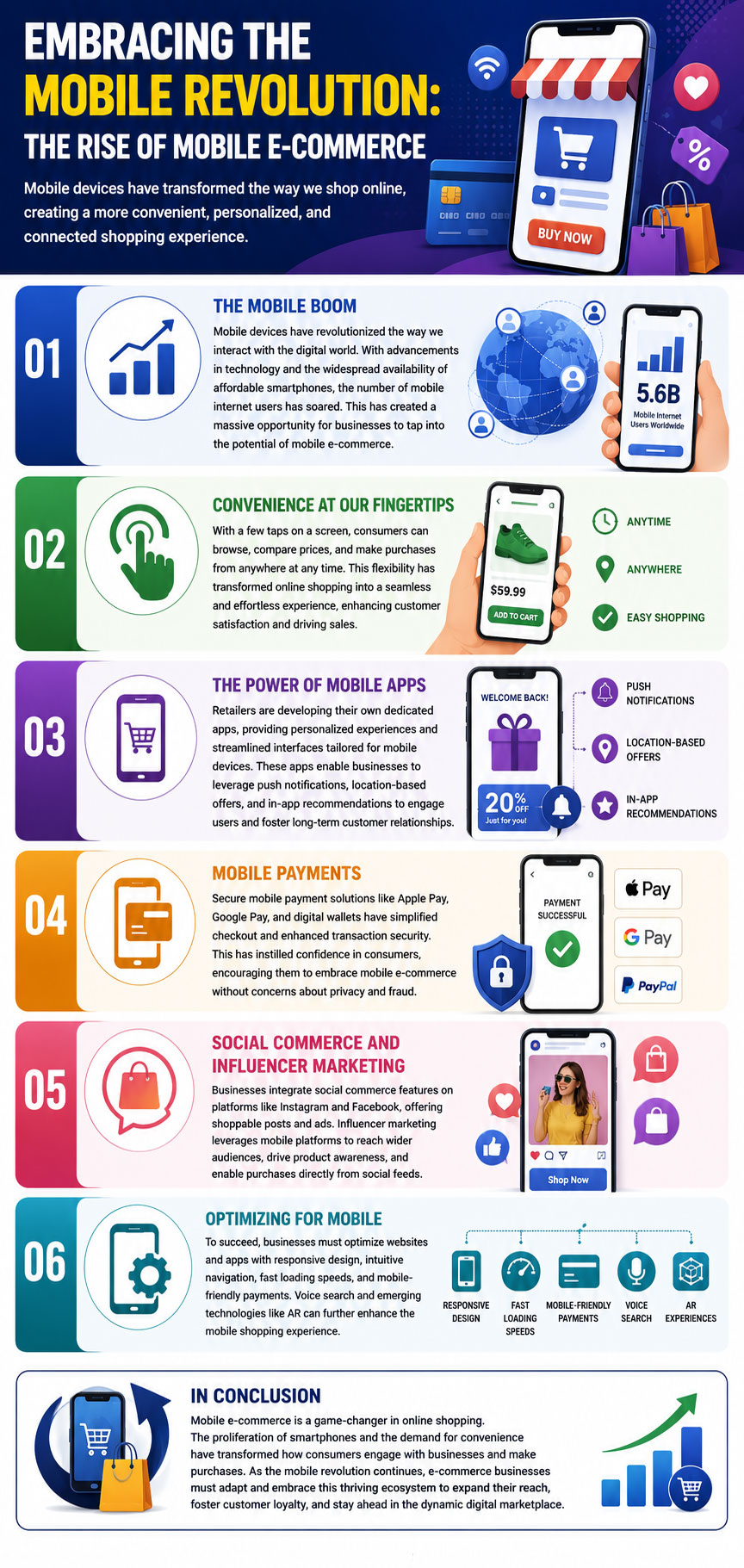
    The Mobile Boom

    Mobile devices have revolutionized the way we interact with the digital world. With advancements in technology and the widespread availability of affordable smartphones, the number of mobile internet users has soared. This has created a massive opportunity for businesses to tap into the potential of mobile e-commerce.

    Convenience at Our Fingertips

    One of the main reasons for the rapid growth of mobile e-commerce is the convenience it offers. With a few taps on a screen, consumers can browse, compare prices, and make purchases from anywhere at any time. This flexibility has transformed online shopping into a seamless and effortless experience, enhancing customer satisfaction and driving sales.

    The Power of Mobile Apps

    Mobile apps have played a crucial role in the success of mobile e-commerce. Retailers are developing their own dedicated apps, providing personalized experiences and streamlined interfaces tailored for mobile devices. These apps enable businesses to leverage push notifications, location-based offers, and in-app recommendations to engage users and foster long-term customer relationships.

    Mobile Payments

    The evolution of secure mobile payment solutions has also contributed to the growth of mobile e-commerce. Digital wallets, such as Apple Pay and Google Pay, along with other mobile payment platforms, have simplified the checkout process and enhanced the security of transactions. This has instilled confidence in consumers, encouraging them to embrace mobile e-commerce without concerns about privacy and fraud.

    Social Commerce and Influencer Marketing

    Mobile devices have become indispensable for social media enthusiasts. Recognizing this trend, businesses have integrated social commerce features within their mobile e-commerce strategies. Platforms like Instagram and Facebook offer shoppable posts and ads, allowing users to discover products seamlessly and make purchases directly from their social feeds. Moreover, influencer marketing has gained traction, leveraging mobile platforms to reach wider audiences and drive product awareness.

    Optimizing for Mobile

    To succeed in the mobile e-commerce landscape, businesses must prioritize optimizing their websites and apps for mobile devices. Responsive design, intuitive navigation, fast loading speeds, and mobile-friendly payment gateways are crucial elements for delivering a frictionless experience. Furthermore, incorporating voice search capabilities and leveraging emerging technologies like augmented reality (AR) can further enhance the mobile shopping experience.

    In conclusion, mobile e-commerce has emerged as a game-changer in the world of online shopping. The proliferation of smartphones fueled by the growing demand for convenience have transformed the way consumers engage with businesses and make purchases. As the mobile revolution continues, it is essential for e-commerce businesses to adapt their strategies and capitalize on this thriving ecosystem. By embracing mobile e-commerce, companies can expand their reach, foster customer loyalty, and stay ahead in the dynamic digital marketplace.